THE PROSPECTOR (El Paso, Texas) – November 29, 1973
—FLASH—
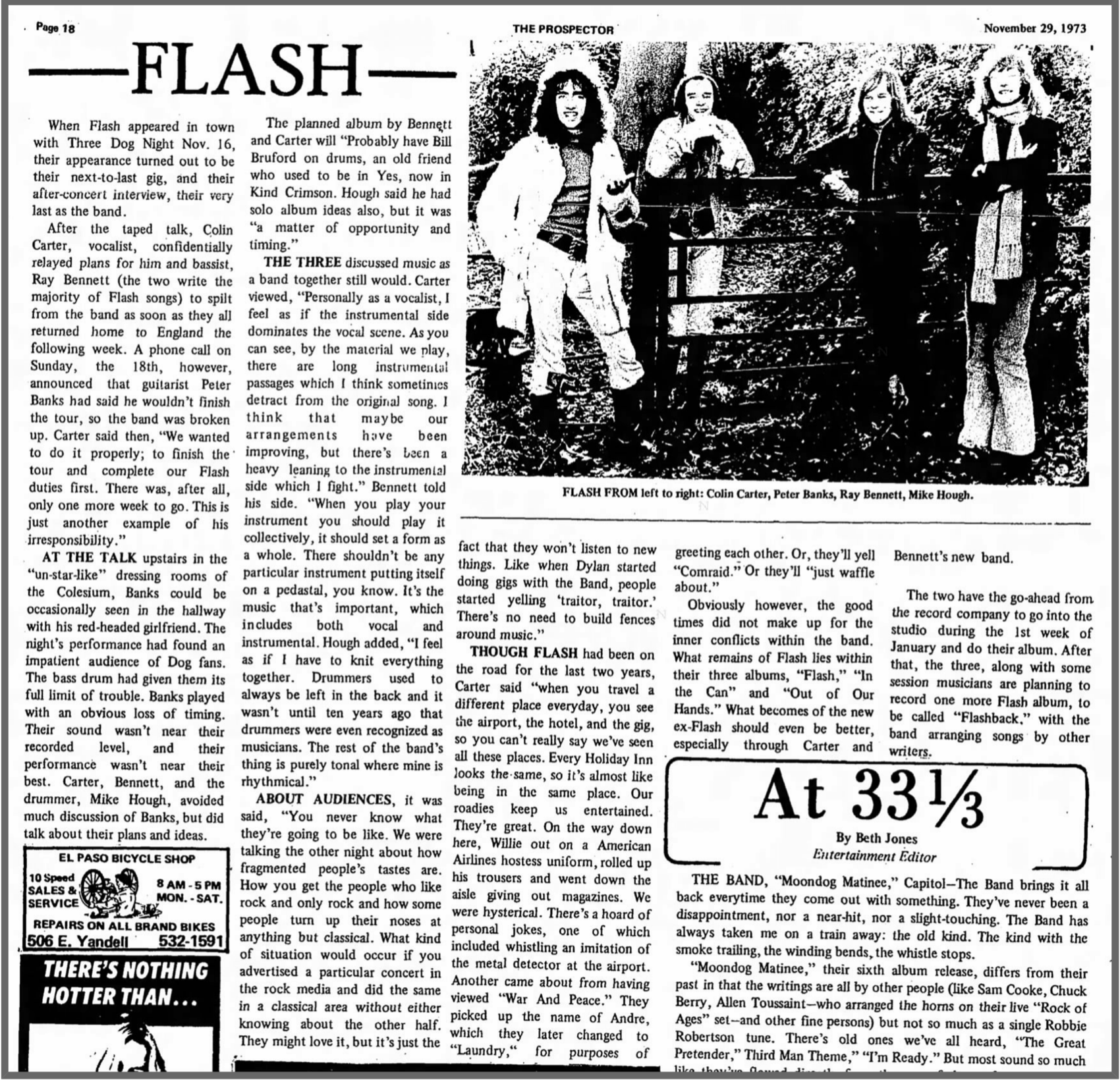
Photo caption: FLASH FROM left to right: Colin Carter, Peter Banks, Ray Bennett, Mike Hough.
When Flash appeared in town with Three Dog Night Nov. 16, their appearance turned out to be their next-to-last gig, and their after-concert interview, their very last as the band.
After the taped talk, Colin Carter, vocalist, confidentially relayed plans for him and bassist, Ray Bennett (the two write the majority of Flash songs) to spilt [sic] from the band as soon as they all returned home to England the following week. A phone call on Sunday, the 18th, however, announced that guitarist Peter Banks had said he wouldn’t finish the tour, so the band was broken up. Carter said then, “We wanted to do it properly; to finish the tour and complete our Flash duties first. There was, after all, only one more week to go. This is just another example of his irresponsibility.”
AT THE TALK upstairs in the “un-star-like” dressing rooms of the Colesium [sic], Banks could be occasionally seen in the hallway with his red-headed girlfriend. The night’s performance had found an impatient audience of Dog fans. The bass drum had given them its full limit of trouble. Banks played with an obvious loss of timing. Their sound wasn’t near their recorded level, and their performance wasn’t near their best. Carter, Bennett, and the drummer, Mike Hough, avoided much discussion of Banks, but did talk about their plans and ideas.
The planned album by Bennett and Carter will “Probably have Bill Bruford on drums, an old friend who used to be in Yes, now in Kind Crimson [sic]. Hough said he had solo album ideas also, but it was “a matter of opportunity and timing.”
THE THREE discussed music as a band together still would. Carter viewed, “Personally as a vocalist, I feel as if the instrumental side dominates the vocal scene. As you can see, by the material we play, there are long instrumental passages which I think sometimes detract from the original song. I think that maybe our arrangements have been improving, but there’s been a heavy leaning to the instrumental side which I fight.” Bennett told his side. “When you play your instrument you should play it collectively, it should set a form as a whole. There shouldn’t be any particular instrument putting itself on a pedastal [sic], you know. It’s the music that’s important, which includes both vocal and instrumental. Hough added, “I feel as if I have to knit everything together. Drummers used to always be left in the back and it wasn’t until ten years ago that drummers were even recognized as musicians. The rest of the band’s thing is purely tonal where mine is rhythmical.”
ABOUT AUDIENCES, it was said, “You never know what they’re going to be like. We were talking the other night about how fragmented people’s tastes are. How you get the people who like rock and only rock and how some people turn up their noses at anything but classical. What kind of situation would occur if you advertised a particular concert in the rock media and did the same in a classical area without either knowing about the other half. They might love it, but it’s just the fact that they won’t listen to new things. Like when Dylan started doing gigs with the Band, people started yelling ‘traitor, traitor.’ There’s no need to build fences around music.”
THOUGH FLASH had been on the road for the last two years, Carter said “when you travel a different place everyday, you see the airport, the hotel, and the gig, so you can’t really say we’ve seen all these places. Every Holiday Inn looks the same, so it’s almost like being in the same place. Our roadies keep us entertained. They’re great. On the way down here, Willie out [sic] on a [sic] American Airlines hostess uniform, rolled up his trousers and went down the aisle giving out magazines. We were hysterical. There’s a hoard [sic] of personal jokes, one of which included whistling an imitation of the metal detector at the airport. Another came about from having viewed “War And Peace.” They picked up the name of Andre, which they later changed to “Laundry,” for purposes of greeting each other. Or, they’ll yell “Comraid [sic].” Or they’ll “just waffle about.”
Obviously however, the good times did not make up for the inner conflicts within the band. What remains of Flash lies within their three albums, “Flash,” “In the Can” and “Out of Our Hands.” What becomes of the new ex-Flash should even be better, especially through Carter and Bennett’s new band.
The two have the go-ahead from the record company to go into the studio during the 1st week of January and do their album. After that, the three, along with some session musicians are planning to record one more Flash album, to be called “Flashback,” with the band arranging songs by other writers.
The Prospector (El Paso, Texas), 29 November 1973, printed page 18. No byline is printed on the Flash article; the “By Beth Jones” line on the adjoining “At 33 1/3” column belongs to that column. Transcribed as printed; original spellings are retained and marked [sic]. Clipped from Newspapers.com.