LOS ANGELES FREE PRESS – August 25, 1972
Yes to new act
Flash at the Whisky
PETER JAY PHILBIN
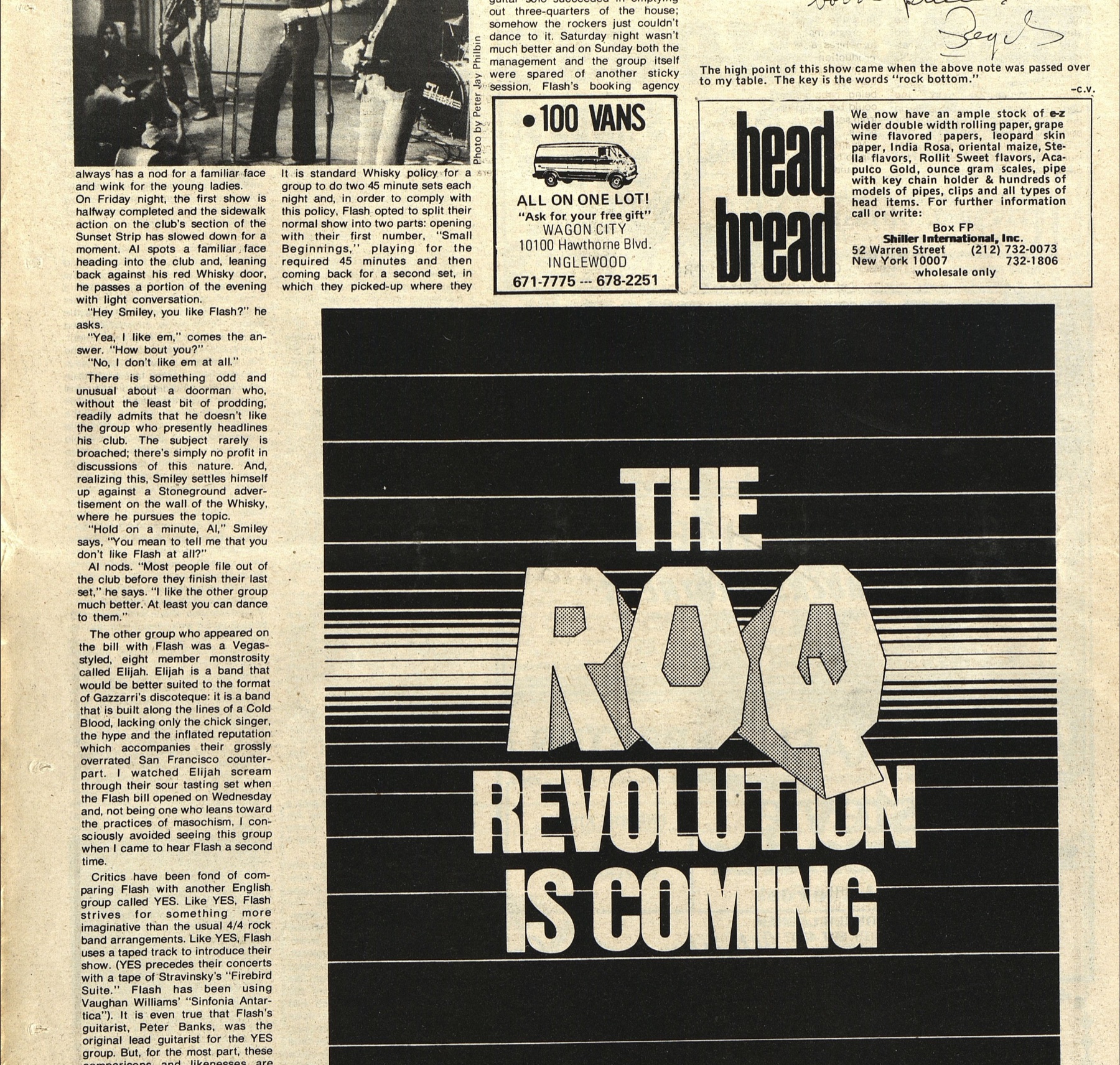
‘Al has worked the door at the Whisky A-Go-Go for three years. He’s the stylish, black dude who checks the customers’ identifications and stamps the hands of the underaged rockers. Mind you, he’s an amiable fellow, one who always has a nod for a familiar face and wink for the young ladies.
On Friday night, the first show is halfway completed and the sidewalk action on the club’s section of the Sunset Strip has slowed down for a moment. Al spots a familiar face heading into the club and, leaning back against his red Whisky door, he passes a portion of the evening with light conversation.
“Hey Smiley, you like Flash?” he asks.
“Yea, I like em,” comes the answer. “How bout you?”
“No, I don’t like em at all.”
There is something odd and unusual about a doorman who, without the least bit of prodding, readily admits that he doesn’t like the group who presently headlines his club. The subject rarely is broached; there’s simply no profit in discussions of this nature. And, realizing this, Smiley settles himself up against a Stoneground advertisement on the wall of the Whisky, where he pursues the topic.
“Hold on a minute, Al,” Smiley says, “You mean to tell me that you don’t like Flash at all?”
Al nods. “Most people file out of the club before they finish their last set,” he says. “I like the other group much better. At least you can dance to them.”
The other group who appeared on the bill with Flash was a Vegas-styled, eight member monstrosity called Elijah. Elijah is a band that would be better suited to the format of Gazzarri’s discoteque: it is a band that is built along the lines of a Cold Blood, lacking only the chick singer, the hype and the inflated reputation which accompanies their grossly overrated San Francisco counterpart. I watched Elijah scream through their sour tasting set when the Flash bill opened on Wednesday and, not being one who leans toward the practices of masochism, I consciously avoided seeing this group when I came to hear Flash a second time.
Critics have been fond of comparing Flash with another English group called YES. Like YES, Flash strives for something more imaginative than the usual 4/4 rock band arrangements. Like YES, Flash uses a taped track to introduce their show. (YES precedes their concerts with a tape of Stravinsky’s “Firebird Suite.” Flash has been using Vaughan Williams’ “Sinfonia Antartica [sic].”) It is even true that Flash’s guitarist, Peter Banks, was the original lead guitarist for the YES group. But, for the most part, these comparisons and likenesses are pointless and superficial. Certainly Flash fits into a new genre of rock music, a genre which includes: YES, ELP, King Crimson and Pink Floyd; but there are immense differences between the groups in this genre. Just as the YES group is best at being YES, so the Flash band is best at being Flash.
The flashiest member of Flash is lead singer. [sic] Colin Carter. A Roger Daltry [sic] look alike, Colin radiates with a presence of stardom. He is one of those rare performers who instinctively brings charisma onto the stage and, when he is singing, the Flash band is at its strongest. Unfortunately, the emphasis in Flash’s sets at the Whisky often drifted away from Carter.
The Whisky was the first place on this tour where Flash wasn’t allowed to play their regular show, a show which has been designed with a specific beginning, middle and end. It is standard Whisky policy for a group to do two 45 minute sets each night and, in order to comply with this policy, Flash opted to split their normal show into two parts: opening with their first number, ‘Small Beginnings,’ playing for the required 45 minutes and then coming back for a second set, in which they picked-up where they had left off an hour earlier.
“It was like stopping in the middle of a sentence and then, all of a sudden, finishing it up a day later,” said Colin Carter.
It was obvious that the Whisky format detracted from the effect of Flash’s show and it was equally obvious that Peter Banks, the group’s talented and temperamental guitarist, strongly objected to this format. Still, on opening night the situation seemed bearable and, if Banks was a bit excessive when it came to guitar solos, bassist Ray Bennett and drummer Mike Hough filled in the bottoms nicely. But Thursday night the band refused to play a second set and, when they did do a second set on Friday, Banks persisted in rendering a lengthy and laborious guitar solo right in the middle of “Dreams Of Heaven.” This guitar solo succeeded in emptying out three-quarters of the house; somehow the rockers just couldn’t dance to it. Saturday night wasn’t much better and on Sunday both the management and the group itself were spared of another sticky session, Flash’s booking agency brought in another one of their acts as a suitable replacement; the group, Fog Hat, began its Whisky engagement a night early.
It is not unusual for a large stage band to play the Whisky. The club is a showcase; many groups have played there for the purpose of exposure and have gone on and gained gigantic followings. Exposure was what Rick Roger, the head of East-West Talent, had in mind when he booked Flash into the Whisky; unfortunately the booking turned out to be a bad marriage.
The Whisky dates can be looked upon as the low point, the poorist [sic] showing of Flash’s first American tour.
Christopher Milk at the Whisky
[Handwritten note, reproduced in the original:]
Chris,
When does your band go on —?
You can pick up
Mr. Twister[?] at rock
bottom price.
[signature illegible]
The high point of this show came when the above note was passed over to my table. The key is the words “rock bottom.”
–C.V.
Los Angeles Free Press, 25 August 1972, Part One, page 16. Transcribed as printed; original spellings are retained and marked [sic]. The page scan is from JSTOR. The photograph is credited to Peter Jay Philbin.